On October 12th, the Norwegian Nobel Committee announced
that the European Union was the winner of the 2012 Nobel Peace Prize. The
committee explained its decision, stating:
"The EU is currently
undergoing grave economic difficulties and considerable social unrest. The
Norwegian Nobel Committee wishes to focus on what it sees as
the EU's most important result: the successful struggle for
peace and reconciliation and for democracy and human rights. The union and
its forerunners have for over six decades contributed to the advancement of peace
and reconciliation, democracy and human rights in Europe."
Nobel Peace Prize Medallion superposed on the EU Flag.
Many in the public have been quick to criticize the
Norwegian Nobel Committee's decision to award organization's
peace prize to the European Union. The announcement was met with
controversy for a variety of
reasons, and much of the controversy surrounding the decision involved
perennial criticisms of the Norwegian
Nobel Committee. Many have criticized the committee for its perceived Eurocentrism,
as well as its perceived political and ideological bias.
I recently read an opinion piece written by Fiamma
Nirenstein, Vice President of the Committee on Foreign Affairs of the Italian
Chamber of Deputies. Nirenstein criticized the decision as "unbearably
politically correct." Before reading her piece on the Norwegian Nobel
Committee's decision, I had never heard of Nirenstein. After some investigating
via Google, I found out that Nirenstein also serves as a columnist for il Giornale, an Italian newspaper that
has generally been characterized as promoting a right-wing ideology. The
majority of Nirenstein's criticism of the Norwegian Nobel Committee's decision
revolves around her disagreement with some of the European Union's policies.
Still, Nirenstein does not address any of the reasons the committee awarded the
Nobel Peace Prize to the European Union. Rather than reject the idea of the
European Union having unified the continent, she argues that the European
Union's policies have significantly harmed the economy, as well as that those
policies do not appropriately address the threat posed by radical Islam.

Even small businesses
have addressed the controversy.
I also recently read an opinion piece written by Gwynne
Dyer, a London-based independent Canadian journalist, that I found much more
agreeable. Dyer's opinion piece primarily tries to make the point that much of
the controversy surrounding the Norwegian Nobel Committee results from Nobel
Peace Prize's somewhat unsuitable title. According to Dyer, the prize "should actually be the Nobel Democracy and Human Rights
Prize". Dyer cites many of the European Union's accomplishments
concerning the promotion democracy and the recognition of human
rights. Still, Dyer does recognize some of the downfalls of the European
Union. In his article, Dyer criticizes the European Union for its
"democratic deficit" at the bureaucratic level. He also gives more
credit to the United Nations for the promotion of democracy and the advancement
of human rights. Still, states his belief that the European Union deserves of
the award.
No one (or nothing) is
perfect. I think as long as the Norwegian Nobel Committee continues
calling it the Nobel Peace Prize, the announcement of every recipient of the
award will be met with controversy. Can anyone, or anything, live up to an
award celebrated as a Peace Prize?
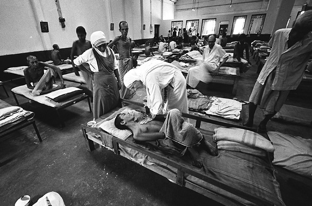
Mother Teresa of Calcutta, 1979 Nobel Peace Prize
Winner.