Monday, October 29, 2012

On 2012 Nobel Peace Prize & the EU, by Jameson Goetz


On October 12th, the Norwegian Nobel Committee announced that the European Union was the winner of the 2012 Nobel Peace Prize. The committee explained its decision, stating:
"The EU is currently undergoing grave economic difficulties and considerable social unrest. The Norwegian Nobel Committee wishes to focus on what it sees as the EU's most important result: the successful struggle for peace and reconciliation and for democracy and human rights. The union and its forerunners have for over six decades contributed to the advancement of peace and reconciliation, democracy and human rights in Europe." 


Nobel Peace Prize Medallion superposed on the EU Flag.

Many in the public have been quick to criticize the Norwegian Nobel Committee's decision to award organization's peace prize to the European Union. The announcement was met with controversy for a variety of reasons, and much of the controversy surrounding the decision involved perennial criticisms of the Norwegian Nobel Committee. Many have criticized the committee for its perceived Eurocentrism, as well as its perceived political and ideological bias.  
I recently read an opinion piece written by Fiamma Nirenstein, Vice President of the Committee on Foreign Affairs of the Italian Chamber of Deputies. Nirenstein criticized the decision as "unbearably politically correct." Before reading her piece on the Norwegian Nobel Committee's decision, I had never heard of Nirenstein. After some investigating via Google, I found out that Nirenstein also serves as a columnist for il Giornale, an Italian newspaper that has generally been characterized as promoting a right-wing ideology. The majority of Nirenstein's criticism of the Norwegian Nobel Committee's decision revolves around her disagreement with some of the European Union's policies. Still, Nirenstein does not address any of the reasons the committee awarded the Nobel Peace Prize to the European Union. Rather than reject the idea of the European Union having unified the continent, she argues that the European Union's policies have significantly harmed the economy, as well as that those policies do not appropriately address the threat posed by radical Islam. 
Even small businesses have addressed the controversy.

I also recently read an opinion piece written by Gwynne Dyer, a London-based independent Canadian journalist, that I found much more agreeable. Dyer's opinion piece primarily tries to make the point that much of the controversy surrounding the Norwegian Nobel Committee results from Nobel Peace Prize's somewhat unsuitable title. According to Dyer, the prize "should actually be the Nobel Democracy and Human Rights Prize". Dyer cites many of the European Union's accomplishments concerning the promotion democracy and the recognition of human rights. Still, Dyer does recognize some of the downfalls of the European Union. In his article, Dyer criticizes the European Union for its "democratic deficit" at the bureaucratic level. He also gives more credit to the United Nations for the promotion of democracy and the advancement of human rights. Still, states his belief that the European Union deserves of the award.
No one (or nothing) is perfect. I think as long as the Norwegian Nobel Committee continues calling it the Nobel Peace Prize, the announcement of every recipient of the award will be met with controversy. Can anyone, or anything, live up to an award celebrated as a Peace Prize?
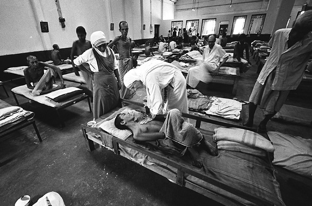
Mother Teresa of Calcutta, 1979 Nobel Peace Prize Winner.


Territorial Arrangement, by Christopher Michels


Right off the bat the topic of Territorial arrangement of political systems seemed interesting to me. Being a History major with a focus on United States History, this is one topic that I at least know the basics about. Today, because the power has already been split thanks to our founding fathers, the idea of territorial arrangement seems like there is a simple solution. However, if one looks into American History, even the founding fathers were pretty evenly split on how to approach this tough arrangement and had many quarrels. This is proved through historical documents such as the Federalist and Anti-Federalist papers. Although they reached a decision and split the government between state to state and national system, it didn’t end there.

Even today in the United States, which is a country that many other countries look to when searching for democracy or leadership, is still trying to figure out where the national government ends and the state governments begin. And if a well-established Democracy such as America still cannot quite get it right, this proves how difficult it could be to other countries trying to obtain what we have, rich or poor, such as Ethiopia, according to John T. Ishiyama. (page 209) I have the opinion of many, and that is that whatever the combinations and distribution of power, each has its pros and cons. This has proven to be true in my own country, and I am sure it can be said of other countries as well. Ishiyama points out that there are Three major systems, and they are Unitary, Federal, and Confederal. Each is striking and works in its own way, but each can also lead to problems such as a thirst for power, or a failure to get anything done.

Unitary System is the most popular choice among countries. One of these countries is China. Pros and cons quickly come to mind when China's name gets dropped. A major pro is that laws are passed more quickly, more effectively, and everyone gets treated rather than it differing territory to territory. Because there is less time for debating, there could be advantages such as a stable economy. However, individuality can be lost. A thought that comes to mind is the famous photo of one man standing in front of a tank before he gets trampled. Whether or not this is the direct effect of a Unitarian philosophy, it is a great analogy of how individual voices are all but lost. I can see how a unitary system could be effective for other countries, but I think it could never work for America for the simple reason of size. Countries with a unitary system such as France and China are not nearly as big as the United States, and due to the fact that America is split into 50 states alone proves how difficult the task could be. This problem especially rings true for problems such as the court system in America. Although in many countries with unitary systems still have smaller governments, their power is still given by the main government, which can lead to sticky situations, inequality, and questionable leadership.

A system that hits closer to home is, of course, the Federal System. This is the system that America has chosen to adopt, and it too, just as the unitary system, has proven to be effective and ineffective in different areas. The point I made before on size of the country being a factor in a certain system can be backed up by the mere fact that both America and Russia, two of the largest countries in the world, are Federal. A major problem with a federal system is the problem of overlapping. Because this is considered a blog essay, my opinion is pivotal to get my thought across. My thoughts when it comes to overlapping is simple, I agree that it is a problem. Though I think problems in this Country do get solved, I find overlapping to be extremely confusing. An example that comes to mind is gay marriage. Right now state governments are treating the problem differently, but like many large issues from the past, it is only a matter of time before it goes to the Supreme Court. This begs the question of who has more power, and if states should be able to differ on key issues. This same issue, however, proves how the Federal system is effective.

Homosexuals can be compared to other struggling minorities from the past. They are fighting for, in their words, “equal rights”.  The reason I put that phrase in quotation marks is because a major battle that has and is continuing to break out is the definition of rights. Some do not see the rights of homosexuals the same way they see the rights of men and women, different races, or even different age groups. The LGBT community, however, sees this problem as a basic problem of their human rights not being met. The reason freedom of speech and groups such as the LGBT community can have a voice as loud as they do is in part, because of the Federal System the United States adopted. Quick responsiveness is due to Federal System, for it does not take as long for a voice to be heard if the government is split into smaller groups.

The third system is a Confederal System, which to be honest, is the system I know the least about. The farthest my knowledge goes is the Civil War, when the South called itself the Confederacy. Three of the four examples Ishiyama gave when naming Confederal Systems are no longer the systems used today, and the fourth is the European Union, which is not that old. The major con I have gathered from reading the textbook is how weak they are. It is much harder for a smaller government within a larger one to have its voice heard. Confederal systems, in my opinion, seem, at best, to have only one pro, and that is to annoy the larger government and be part of the veto system in order for a problem to be looked at. The problem with this, is, depending on the Confederal systems size and problem, they can be put to a halting stop, such as in the Civil War.

Territorial Arrangements of Government is fascinating for the simple reason that no two are the same, but often times, they have worked for hundreds of years. This is important to look at when comparing governments, because it can give insight to how governments work and operate. Personally, im a fan of the Federal system, but then again, I am extremely biased. I don’t think a Unitarian System is horrible either, for it is proven to be effective. I am just glad the confederal system in America did not succeed after they succeeded.

Source: Comparative Politics: Principles of democracy and democratization. By John T. Ishiyama

Capital Punishment in the US


Brave Soldiers of Comparative Politics!

Here is a map, complementing our class discussion on federalism:

 Capital punishment in the US. 

     SD has it, fellow Vikings in Minnesota don't!
E.C.W.

Capital Punishment in Comparative Perspective


Folks, this is from me.
Supplementary info from around the world, upon our class discussion over death penalty
    E.C.W.

Ethnic Conflicts, by Anonymous 1


            In 1994 Rwanda’s population reached seven million. Three groups were organized according to their beliefs: Hutu, Tutsi, and Twa. Hutu is the majority that makes up 86 percent of the population, and Tutsi is 14 percent. And Twa is made of 1 percent of the entire population. A decade ago, we had a genocide caused by the conflicts between two groups, Tutsi and Hutu, and the President Habyarimana was killed after his plane was shot down and crashed. Hutu decided to declare genocide against all Tutsis; they received an order from the headquarters of the rebel leader. The massive killing of Tutsi began after the death of their president.


 The Rwandan genocide resulted in eliminating Tutsis. Even though Tutsi were an ethnic minority, they did not want the majority group to occupy them. Hutu did not want to sign an agreement to share power with the minority group. Both groups disagreed and the conflict erupted like a volcano. These are some problems that people could have solved peacefully, instead of using deadly force.

The Rwandan Tutsis looked up to the UN and United States to stop this violence, but they were ignored as if nothing were happening. “Not only did international leaders reject what was going on, but they also declined for weeks to use their political and moral authority to challenge the legitimacy of the genocidal government.” Rwanda’s Tutsi were shocked and hopeless because they know they were going to get slaughtered. We always ask ourselves why the world did not react. 

             Tutsis were suffering, waiting for help until the last moment. Tutsi rebels could not do anything because they did not have enough ammunition to defeat government rebels. Secondly, France and the UN had their forces there to protect civilians, but that is not what they did. They were silent killers. Tutsi rebels were not needed until the last moment when the UN abandoned innocent civilians to get slaughtered in front of their eyes. “They refused to declare that a government guilty of exterminating its citizens would never receive international assistance.” Why did they not receive international assistance? The UN was guilty of not doing so.

The UN was in charge of protecting civilians. Even today we still ask the United Nations questions about why they did this to us; their response is still unclear. There must be someone behind this bloodbath. France gave deadly weapons to use against these civilians. According to the Human Rights Watch, the United States and the United Nations were aware of the preparations for massive slaughter and failed to take the steps needed to prevent it from happening. How come the United States of America did not stop France from supporting the killings? France was hosting the genocide in Rwanda. The international community did not investigate or question France for violating human rights. France gave machetes to the rebels that call themselves “Interahamwe,” a terrorist organization that seeks to overthrow the government using coup d’etat or using deadly force. These Interahamwe received weapons supplies from France and Tutsi had enough evidence and facts to prove how France was the behind the crimes.  

The government of France was accountable for the massive killing of innocent civilians, and it was in charge of the genocide. Even today Tutsi are being targeted in Congo by Interahamwe, and they are accused of much crime in Congo. Rwandese Patriotic Front (RPF) is hunting these criminals who committed genocide. According to Gatumba survivors, in 2004 Tutsi were targeted again in Burundi, in small city called Gatumba, where 166 lost their lives. These 166 were innocent people who fled to Burundi for their safety. Again, the international community did not do anything to bring justice. They were refuges and still got killed. The Interahamwe seemed to have violated the international law of not killing civilians. After France started the genocide, they left so that Hutu could finish up their mission. It did not take that long for RPF to react against this killing. The genocide lasted for one hundred days.

Now, Tutsi rebels have one choice of dying trying or fight against the government. At that time Paul Kagame was the rebel leader for Tutsi rebels, they decided to take an action against the government regimes. According to the United Nations Human Right Council “The civil war and genocide only ended when the Tutsi-dominated rebel group, the RPF, defeated the Hutu perpetrator regime and President Paul Kagame took control. But it was too late, 8,000 people were already being murdered. If the RPF did not defeat Hutu perpetrator Tutsi will be wiped out from Rwanda. Now the minority have been in control of the government since 1994.

France has been accused of hosting the genocide. Who can bring France to justice? Genocide survivors are still waiting for justice to be done. French government is holding some criminals from Rwandan genocide. The international court did not do anything to bring France to justice. Justice must be served fairly and equally. Rwandan government is doing its best to prevent the genocide from happening again. France does not have a diplomatic corps or an ambassador in Rwanda because they committed a crime against humanity. France is doing its best to build a good relationship with the Rwanda government. According to Lignet.com since 2007 after Nicolas Sarkozy was elected he tried to improve and restore the relationship with Rwanda.

They suffered to recover, but today Rwanda is continuing to grow and improve; and develop its economy. Today in Rwanda, if you called someone a Tutsi or Hutu you will to go to prison. It is a felony against the humanity. All citizens are equal; they do this so that they could prevent genocide. I highly recommend going to see the beauty of Rwanda and its culture.

Sources:  
http://www.unitedhumanrights.org/genocide/genocide_in_rwanda.htm
                                                                
http://www.lignet.com/InBriefs/Rwanda-France-Relations-Will-Likely-Improve-In-Aft.aspx

On US, Britain, China, Great Power Politics, Democratic Waves, and Huntington, by Christopher Michels


           When the question came up in class October Second on which country or countries influence the U.S.A, my mind immediately went to England. Fair enough that I would think that, considering they founded this country originally, and the characteristics of that culture are the same characteristics that our country adopted in the 1700’s. Even the way America cuts its grass is from English tradition. Cutting ones grass represented wealth in England, and the tradition of constantly mowing lawns remains today. And though powdered wigs are a thing of the past, there are still traces of the United States modeling itself after England.

            Through tradition, many values today still reflect the early culture of the U.S. A vast majority of the country speaks English; we still abide by the Constitution and look with honor upon the Declaration of Independence. However, aside from these early cultural effects present day United States is more modeled after different countries, such as Japan, China, and even our own neighbors like Canada. China itself has many similarities to the U.S. The U.S and China have the two largest economies in the world, both countries use up most of the world’s oil, and both countries have large populations, China having the largest in the world. (China.usc.edu) Populations are not something that the U.S. models itself after, however, so one must look further into the relationship between the countries to see the relationship. One major aspect of life that the U.S does in fact model after China is our Economy. While our democracy does cause some differences for our economy than theirs, they still have a booming economy, which is something we could learn from, being in the crisis that we are now. China is also a leading country in trying to decrease the amount of greenhouse gasses going into the atmosphere, and in a constantly changing green time, the U.S is right behind China, doing its best to help the environment. The facts are there that the U.S and China are both leading countries of the world today, and because of this, it is nearly impossible for the U.S not to model itself after China. If something China is doing is working well, the U.S will do the same thing to get great results, and vice versa. 

As for other countries that the U.S is modeling itself after, I would say that it’s not many. If anything, the United States tries to make its own path and set an example for other countries. I know that this sounds selfish, and America already has a reputation for being stuck-up, but being a major superpower, America was already thrust into a leadership position. Technology-wise and as far as education goes, the U.S is constantly looking to Japan. And Germany right now has a great economy and the United States is for sure looking at that. Russia is another large superpower that the U.S is always butting heads with, but not so much modeling itself after. The idea of Democracy that America has can go as far back as early Greece, but we twisted it into our own way.

            October Second also brought up the topic of Democracy going up in down, the analogy being waves. The waves of democracy often start with a war, such as in the first, which was triggered after the American and French revolutions. Democracy always seemed like a peaceful idea to me, so it seems strange that violence is a major triggering point. It makes sense however, for through troubled times ideas like Democracy guide peoples actions. Economic and Cultural factors also greatly influence democracy, according to the Stanford News. According to research, working classes rise up through great economic conditions, and they then seek power, which is a triggering point for democracy. This goes hand and hand with capitalism, however, capitalism does not need to be present to trigger Democracy.

            I think that Democracy is different and varies country to country like we discussed in class, some countries may want to become more of a democracy, but do not have the drive, the resources, or the authority to do so. I know that I take advantage of the democracy I have in the United States. While I was given it from birth, others are fighting for it, and blood is constantly being spilt. The majority of the people in the country might not even all want the same thing, which could pose some problems.

            Following with Samuel Huntington’s democratic waves, there also has to be reverse waves too, for waves rise and fall repeatedly. The reverse waves are comprised of military coups and regimes such as the Nazis and Fascists. This is interesting to me, for neither the Nazi party nor the Fascists had the same values as the Democracy in America has. Personally, I think it stinks that there are reverse waves, and I don’t quite understand them. I do not see them as reverse waves as much as struggles in achieving democracy. Democracy cannot be obtained overnight, and now both Germany and Italy have some sort of Democracy going on. They had to learn from their mistakes to get to where they are today.

            I realized while writing the blog that the two topics of conversation in this class correlate to one another. The leading countries in the world such as the United States and China set examples for other cultures, even with our freedom and democracy. This is why the United States and Russia were at odds with one another before, Communism and Democracy were both being pursued by developing countries, and neither country wanted to see their ideals slip through the cracks. The United States of America has a very tough position in the world today. Being a superpower, all eyes are going to be on her. The Democracy she has is an example to all others.


www.uio.no
http://www.uio.no/english/research/interfaculty-research-areas/democracy/news-and-events/events/conferences/2012/papers-2012/Strand-Hegre-Gates-Dahl-wshop7.pdf
China.Usc.Edu
http://china.usc.edu/ShowArticle.aspx?articleID=1543&AspxAutoDetectCookieSupport=1

Cartoon on Comparative Subjugation of Women, suggested by Florencia Magni


Folks, this Comparative Politics course is truly a global tour d'horizon!

Let's open our eyes to how politics is done around the world!

But when things look grim,

Let's try to maintain a healthy sense of humor..:)

Feel free to suggest your favorite editorial cartoons for our blog!
Dr. E.C.Wiltse