Monday, October 29, 2012

Globalization, by Cole Meunier

Psy “Gangnam Style”           

Globalization, “worldwide integration and development” according to www.dictionary.com. Whether you like it or not it is here to stay. I personally think it can only occur faster. Everywhere you look there are influences from around the world whether it's art, music, or even tangible goods. With modern technology becoming readily available around the world it creates an even broader spectrum of cultures merging with one another. 

Globalization is one way that the ideology of Democracy is spread. When most people think of it (globalization), I feel that they are thinking of it from a manufacturing form of view. Whether it be bananas from South America, a new BMW from Germany, or tea from India. I personally think of it as the spreading of ideas. Sure you can get tangible goods from other countries but with the internet you can transport ideas across the ocean or country. As a nation you can only get better by comparing yourself as a whole to another. This leads to competition on a global scale making better products and the merging of ideas to become even greater than they once were.

With globalization, many new technologies have emerged to help spread ideas and culture. Look at Facebook or Twitter, it has created a place where just about anyone in the world can communicate with each other and spread ideas. Some would even point to the Arab Spring as utilizing these resources to help with their struggles of overcoming abusive dictatorships. The abused citizens started off these revolutions by organizing peaceful protests for many to join in. This became widely popular with hundreds of thousands of protestors attending these events. But of course these technologies are not only for revolutions, but have also been widely used for the spreading of art. For example Youtube has made it easier for people to engage in many different cultures.

I remember when I was a lot younger and going on Youtube and watching funny videos with friends. Over the years I have noticed the website becoming more multi-cultural with videos. It is not uncommon to see videos from Russia, Germany, or many other states around the world. In fact in recent years it has even become fairly normal from many other states become popular around the world. Take Psy, he is a South Korean rapper who has become wildly popular with his most recent video getting over 476,332,414 views in exactly three months and still rising. It has hit number one in the charts in the US, Korea, Australia, Canada, Germany, Ireland, Norway, New Zealand, Switzerland, and the UK. These are all very different markets yet someone from South Korea can manage to influence all of these states. Just imagine if you can influence all states with an ideology, and emergence of cultures.

Yet Psy is not the only popular artist in the United States from another state. Volbeat is a rock band from Denmark and has become very popular in the rock scene here in the United States, but other countries are not the only ones influencing culture around the world. Many other countries are affected from the US through globalization. Look as movies and TV shows. There are tons of American shows that are either broadcasted around the world or adjusted to mesh into the culture of the nation. Look at America's Got Talent, many other states have created their own version from India to Britain to South Korea. I believe that if the world finds more things that we have in common, globalization will only occur that much faster helping create new and better products and ideas.

On Death Penalty, South Dakota & Minnesota, by Michael Wermers


Today a man was put to death for the murder of a prison guard.  This is only the third execution in South Dakota in the last 65 years; one 65 years ago, one five years ago, and today.  South Dakota is one of many states in America that holds a penalty of death for certain crimes.  In the United States most crime punishments are set at a federal level.  The federal level of punishment is the base punishment level for the states.  The individual states can then decide to make the punishment more severe. The states cannot make the punishment less severe than the federal government level.  This has both positive and negative implications for those committing the crimes.  The punishment of death is a perfect example.  For example, Minnesota does not have the death penalty for any crimes.  If the murder of the prison guard occurred in Minnesota the murder could not be sentenced to death.  Another example would be the legalize use of marijuana, even for only medically necessary, in California.  In this case California’s law is less stringent than the federal governments.  So, while California will not prosecute the users the federal government could still go in and shut down the growers, and prosecute both the growers and users.
Coming back to states setting penalties more severe than the federal government, the fact that states can set penalty levels different from each other may cause great concern for the law-abiding citizen of many states.  I may be hard to fathom murders would be more active in states without the death penalty, and I would concede there is not a lot of credibility in that argument.  Even if that is the case it may be very likely that drug dealers and traffickers will be more active in state with less severe penalty.  In accepting this argument it is also important to understand that the act still needs to result in a crime.  Sticking with drug crimes, if drug use is legalized in a state, the price will go down, and the drug dealers will move on.  Where drugs are still illegal the price will stay high, and it will be more advantages for the drug dealers to pursue their trade in states with lower penalties.
Even though a state may make the punishment more severe than the federal set punishment, a federal punishment may be added to the state punishment.  For example, if you commit a felony in a state the punishment may be different in Minnesota than it is South Dakota, but the offender will have the federal punishment of no longer being allowed to have a firearm (own, carry, or possession) added to the punishment.
I have received an Associate Degree in Law Enforcement; in so doing I became very familiar with the laws and penalties associated with them in Minnesota.   An area where Minnesota and South Dakota have the same penalty is convicts’ voting rights.  In both of these states, convicts can earn the right to vote back after they have served their term of incarceration, and completed both parole and probation terms.   Differences also exist between the states in what is a crime and what is not, not just the penalty when a crime is committed.  A current example, and a hot button issue, is texting while driving.  It is illegal to text and drive anywhere in Minnesota.  In South Dakota it is illegal to text in drive in Sioux Falls, but not in anywhere else in the state.
What is a crime and what is not?  What is the penalty?  Is it less severe in this state or that?  Should there be more effort to align the crimes and penalties?  France is a country where no matter where you are in the country a crime is a crime and the penalty is the penalty.  There may be an argument to made for this type of uniformity; however, that would not be possible in the United States, because the United States constitution reserves to the states certain unalienable rights.  Among which is the right to establish punishment levels. 

On Persepolis, Catcher in the Rye & How "People are People", by Jameson Goetz


Marji, Persepolis: The Story of a Childhood.
Before I first picked up the book, I had definitely underestimated the potential value of reading Persepolis: The Story of a Childhood. The comic book, written by Marjane Satrapi, demonstrated the potential of comparative study. Political Science 299: Comparative Politics is designed as a method of studying the different governments, specifically each government's level of democratization. We may find ourselves struggling to understand the actions of leaders of foreign governments because we do not entirely understand the variety of factors, including those that deal with economics, religious motivations, and "strange" cultural practices that influence those decisions. Still, we can always find at least some level of mutual understanding with the experiences of other people. Persepolis: The Story of a Childhood successfully adds that human element to our course of study. 

Catholic Nun teaching her “properly dressed” students.

Marjane Satrapi utilizes pop culture references that almost anyone can find relatable. As an alumnus of Catholic Junior High and Catholic High School, I can relate to Marji's frustration with her school's strict dress code, as well as what she perceives as her school's attempts to indoctrinate its students. When I was 14 years old, I remember becoming frustrated with what my school was teaching its students. We all asked a lot of questions, but no one seemed to appreciate our inquisitive nature. When the woman chastises Marji in the street for dressing somewhat quirky, proudly displaying her Michael Jackson and Iron Maiden memorabilia, I definitely could relate to her frustration. How would I have made it through my pre-teen years if I had not been able to proudly display my loyalty to the Minnesota Vikings or my favorite band, Nirvana?  The angst we experience when growing up is obviously a universal phenomenon.
After reading Persepolis: The Story of a Childhood, I became somewhat angry, and I asked myself, "Why had I not read this sooner?" This comic book, although relevant for people of all ages, would have the greatest affect on readers the same age as Marji, the story's main character. Until I traveled to Guatemala, I don't believe I understood the true meaning of the phrase, "the universal human experience". I learned that people are people, and everyone, regardless of their background, tend to have similar desires, regrets, worries, etc.

Holden Caulfield, The Catcher in the Rye.

Although I do not want to discredit the power of traveling abroad and experiencing other cultures, I do not think that we have to wait for such opportunities to begin to understand the concept, "people are people". If I had read this book when I was 14, I believe the experience would have had a noticeable impact on my worldview. When I was in junior high, The Catcher in the Rye was not a part of our schools curriculum (I assume that the school believed that the book's content was unsuitable for a Catholic School). Still, I read the book independent of my English class at school. Reading The Catcher in the Rye was a powerful experience. Holden Caulfield, the book's main character, presented a character universally relatable for almost all teenagers; anybody who read Catcher in the Rye during their early teens understands. 
These books, The Catcher in the Rye and Persepolis: The Story of a Childhood provide an artistic experience that promotes empathy, an emotion that can have nothing but a positive effect on the world. I do not understand why these books, as well as other similar books, do not make up a larger part of middle school and secondary school curriculums. 

 Late Thursday afternoon, after losing a series of attempts to include Hispanic history in state social studies standards, State Board of Education member Mary Helen Berlanga gazed down at a new stack of amendments — stripping victories she thought she had gained at a meeting in January, including the inclusion of Hispanic heroes of the Alamo.” The Texas Tribune

On 2012 Nobel Peace Prize & the EU, by Jameson Goetz


On October 12th, the Norwegian Nobel Committee announced that the European Union was the winner of the 2012 Nobel Peace Prize. The committee explained its decision, stating:
"The EU is currently undergoing grave economic difficulties and considerable social unrest. The Norwegian Nobel Committee wishes to focus on what it sees as the EU's most important result: the successful struggle for peace and reconciliation and for democracy and human rights. The union and its forerunners have for over six decades contributed to the advancement of peace and reconciliation, democracy and human rights in Europe." 


Nobel Peace Prize Medallion superposed on the EU Flag.

Many in the public have been quick to criticize the Norwegian Nobel Committee's decision to award organization's peace prize to the European Union. The announcement was met with controversy for a variety of reasons, and much of the controversy surrounding the decision involved perennial criticisms of the Norwegian Nobel Committee. Many have criticized the committee for its perceived Eurocentrism, as well as its perceived political and ideological bias.  
I recently read an opinion piece written by Fiamma Nirenstein, Vice President of the Committee on Foreign Affairs of the Italian Chamber of Deputies. Nirenstein criticized the decision as "unbearably politically correct." Before reading her piece on the Norwegian Nobel Committee's decision, I had never heard of Nirenstein. After some investigating via Google, I found out that Nirenstein also serves as a columnist for il Giornale, an Italian newspaper that has generally been characterized as promoting a right-wing ideology. The majority of Nirenstein's criticism of the Norwegian Nobel Committee's decision revolves around her disagreement with some of the European Union's policies. Still, Nirenstein does not address any of the reasons the committee awarded the Nobel Peace Prize to the European Union. Rather than reject the idea of the European Union having unified the continent, she argues that the European Union's policies have significantly harmed the economy, as well as that those policies do not appropriately address the threat posed by radical Islam. 
Even small businesses have addressed the controversy.

I also recently read an opinion piece written by Gwynne Dyer, a London-based independent Canadian journalist, that I found much more agreeable. Dyer's opinion piece primarily tries to make the point that much of the controversy surrounding the Norwegian Nobel Committee results from Nobel Peace Prize's somewhat unsuitable title. According to Dyer, the prize "should actually be the Nobel Democracy and Human Rights Prize". Dyer cites many of the European Union's accomplishments concerning the promotion democracy and the recognition of human rights. Still, Dyer does recognize some of the downfalls of the European Union. In his article, Dyer criticizes the European Union for its "democratic deficit" at the bureaucratic level. He also gives more credit to the United Nations for the promotion of democracy and the advancement of human rights. Still, states his belief that the European Union deserves of the award.
No one (or nothing) is perfect. I think as long as the Norwegian Nobel Committee continues calling it the Nobel Peace Prize, the announcement of every recipient of the award will be met with controversy. Can anyone, or anything, live up to an award celebrated as a Peace Prize?

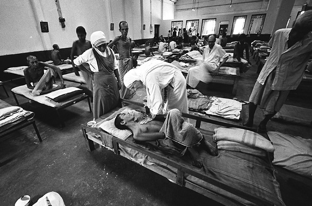
Mother Teresa of Calcutta, 1979 Nobel Peace Prize Winner.


Territorial Arrangement, by Christopher Michels


Right off the bat the topic of Territorial arrangement of political systems seemed interesting to me. Being a History major with a focus on United States History, this is one topic that I at least know the basics about. Today, because the power has already been split thanks to our founding fathers, the idea of territorial arrangement seems like there is a simple solution. However, if one looks into American History, even the founding fathers were pretty evenly split on how to approach this tough arrangement and had many quarrels. This is proved through historical documents such as the Federalist and Anti-Federalist papers. Although they reached a decision and split the government between state to state and national system, it didn’t end there.

Even today in the United States, which is a country that many other countries look to when searching for democracy or leadership, is still trying to figure out where the national government ends and the state governments begin. And if a well-established Democracy such as America still cannot quite get it right, this proves how difficult it could be to other countries trying to obtain what we have, rich or poor, such as Ethiopia, according to John T. Ishiyama. (page 209) I have the opinion of many, and that is that whatever the combinations and distribution of power, each has its pros and cons. This has proven to be true in my own country, and I am sure it can be said of other countries as well. Ishiyama points out that there are Three major systems, and they are Unitary, Federal, and Confederal. Each is striking and works in its own way, but each can also lead to problems such as a thirst for power, or a failure to get anything done.

Unitary System is the most popular choice among countries. One of these countries is China. Pros and cons quickly come to mind when China's name gets dropped. A major pro is that laws are passed more quickly, more effectively, and everyone gets treated rather than it differing territory to territory. Because there is less time for debating, there could be advantages such as a stable economy. However, individuality can be lost. A thought that comes to mind is the famous photo of one man standing in front of a tank before he gets trampled. Whether or not this is the direct effect of a Unitarian philosophy, it is a great analogy of how individual voices are all but lost. I can see how a unitary system could be effective for other countries, but I think it could never work for America for the simple reason of size. Countries with a unitary system such as France and China are not nearly as big as the United States, and due to the fact that America is split into 50 states alone proves how difficult the task could be. This problem especially rings true for problems such as the court system in America. Although in many countries with unitary systems still have smaller governments, their power is still given by the main government, which can lead to sticky situations, inequality, and questionable leadership.

A system that hits closer to home is, of course, the Federal System. This is the system that America has chosen to adopt, and it too, just as the unitary system, has proven to be effective and ineffective in different areas. The point I made before on size of the country being a factor in a certain system can be backed up by the mere fact that both America and Russia, two of the largest countries in the world, are Federal. A major problem with a federal system is the problem of overlapping. Because this is considered a blog essay, my opinion is pivotal to get my thought across. My thoughts when it comes to overlapping is simple, I agree that it is a problem. Though I think problems in this Country do get solved, I find overlapping to be extremely confusing. An example that comes to mind is gay marriage. Right now state governments are treating the problem differently, but like many large issues from the past, it is only a matter of time before it goes to the Supreme Court. This begs the question of who has more power, and if states should be able to differ on key issues. This same issue, however, proves how the Federal system is effective.

Homosexuals can be compared to other struggling minorities from the past. They are fighting for, in their words, “equal rights”.  The reason I put that phrase in quotation marks is because a major battle that has and is continuing to break out is the definition of rights. Some do not see the rights of homosexuals the same way they see the rights of men and women, different races, or even different age groups. The LGBT community, however, sees this problem as a basic problem of their human rights not being met. The reason freedom of speech and groups such as the LGBT community can have a voice as loud as they do is in part, because of the Federal System the United States adopted. Quick responsiveness is due to Federal System, for it does not take as long for a voice to be heard if the government is split into smaller groups.

The third system is a Confederal System, which to be honest, is the system I know the least about. The farthest my knowledge goes is the Civil War, when the South called itself the Confederacy. Three of the four examples Ishiyama gave when naming Confederal Systems are no longer the systems used today, and the fourth is the European Union, which is not that old. The major con I have gathered from reading the textbook is how weak they are. It is much harder for a smaller government within a larger one to have its voice heard. Confederal systems, in my opinion, seem, at best, to have only one pro, and that is to annoy the larger government and be part of the veto system in order for a problem to be looked at. The problem with this, is, depending on the Confederal systems size and problem, they can be put to a halting stop, such as in the Civil War.

Territorial Arrangements of Government is fascinating for the simple reason that no two are the same, but often times, they have worked for hundreds of years. This is important to look at when comparing governments, because it can give insight to how governments work and operate. Personally, im a fan of the Federal system, but then again, I am extremely biased. I don’t think a Unitarian System is horrible either, for it is proven to be effective. I am just glad the confederal system in America did not succeed after they succeeded.

Source: Comparative Politics: Principles of democracy and democratization. By John T. Ishiyama

Capital Punishment in the US


Brave Soldiers of Comparative Politics!

Here is a map, complementing our class discussion on federalism:

 Capital punishment in the US. 

     SD has it, fellow Vikings in Minnesota don't!
E.C.W.

Capital Punishment in Comparative Perspective


Folks, this is from me.
Supplementary info from around the world, upon our class discussion over death penalty
    E.C.W.